
Oven
Temperature Sensor and Calibration
Baking that comes out burnt or pale at the usual setting, traced to the sensor, its wiring or an oven that simply needs calibrating.
Mon–Sat, 8am–8pm
- Low cost band
- 4 steps on the visit
- 5 problems it answers
Book a visit
Three short steps, about a minute.
or call (844) 407-1890
Loading appointment form…
The appointment form couldn’t load. Please try again.
What the oven temperature sensor and calibration
involves.
The oven temperature sensor is a thin metal probe that pokes through the back wall of the cavity and tells the control how hot the air is. Its resistance rises as the oven heats, and the control compares that reading with the temperature you set, switching the elements or the burner on and off to hold it. When the sensor drifts, the oven keeps a steady temperature that is steadily wrong, and recipes that always worked begin to burn or stay underdone. A sensor that fails outright usually brings up a code and stops the oven from heating. This service measures the sensor against a known chart, checks its plug and wiring for heat damage, and calibrates the control once the reading is right.
How the visit goesWhat it usually costsLow · Temperature sensor or calibration
Calibration alone needs no part at all. A new sensor is inexpensive and quick to fit from inside the cavity on most wall ovens.
Answers 5 problemsOven Temperature Not Accurate
Oven Baking Unevenly · Oven Slow to Preheat · Oven Error Code · Oven Won't Turn Off
Comes up most onSingle wall oven
Double wall oven · Steam oven · Speed oven
Codes that lead hereC-20 · C-23 · F30 · F210
Dacor Modernist wall oven showing C-20.
Temperature sensor and calibration,
step by step.
Apply a calibration offset from the control's settings menu where needed and confirm the oven holds its temperature through another cycle.
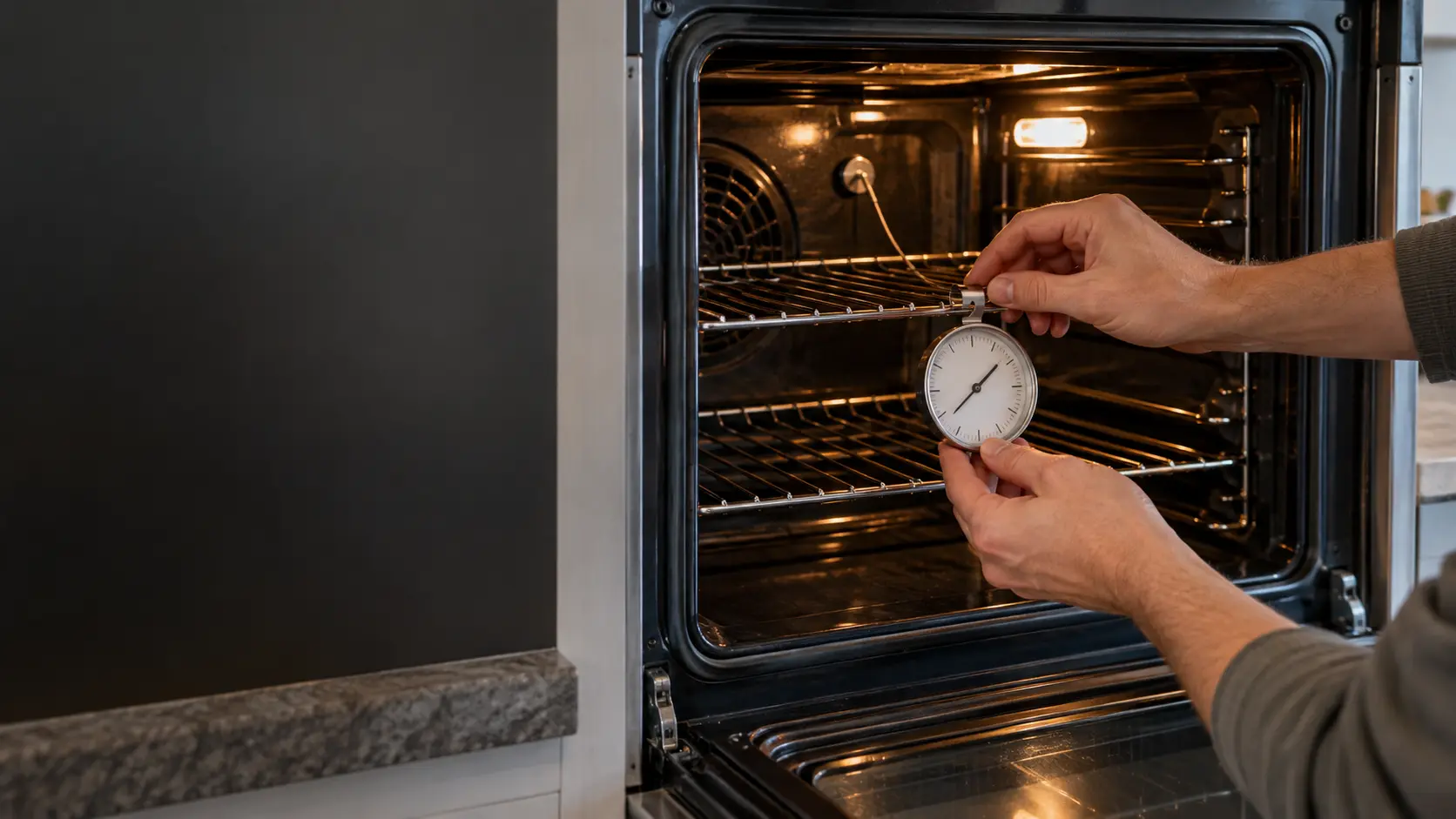
Place a reliable test thermometer in the center of the cavity and record how far the oven drifts from its setting over a full cycle.
Measure the sensor's resistance at room temperature and compare it with the value the manufacturer publishes for the model.
Check the sensor's connector and wiring behind the rear wall for melted insulation or corrosion, and replace the sensor if it reads out of line.
Apply a calibration offset from the control's settings menu where needed and confirm the oven holds its temperature through another cycle.
The problems
it answers.
5 of them, from oven temperature not accurate to oven won't turn off.
All problems
Oven Temperature Not Accurate
5 causes, cheapest first
Before you call
Tell us this when you book
- Whether food is coming out overdone, underdone or unevenly baked
- Roughly how far off you think the oven is, if you have checked it with a thermometer
- Any code the display has shown
- Whether you have already changed the temperature offset in the settings
It also answers
Low,
on the site's scale.
Calibration alone needs no part at all. A new sensor is inexpensive and quick to fit from inside the cavity on most wall ovens.
Read the full cost guide| Repair | Relative cost |
|---|---|
| Door hinges, gasket or door glass | |
| Bake or broil element | |
| Gas igniter, safety valve or burner | |
| Temperature sensor or calibration | low |
| Cooling fan or thermal fuse | |
| Convection fan motor, blade or ring element | |
| Door lock motor and switches | |
| Steam generator, pump or tank sensor | |
| Control board or touch panel |
Where it
comes up most.
Most bookings: Single wall oven, Double wall oven, Steam oven, Speed oven.
All oven types


The makes
we see it on.
30 makes on this site, and the oven temperature sensor and calibration on any of them. Each mark opens that make's own page.
All 30 brandsTemperature sensor and calibration,
where we come out.
The kitchen, the climate and the building all change how the oven temperature sensor and calibration goes. These notes are about that, metro by metro.
All service areasTampa BayFL · 31 areas
Tampa Bay owners often notice a wall oven running hot or cool with a new recipe, and a calibration visit measures the cavity against the setting, checks the sensor's resistance and adjusts the offset where the control allows it.
OrlandoFL · 30 areas
In Orlando's builder-grade wall ovens, a temperature sensor that drifts is a frequent cause of uneven baking, and replacing it takes minutes once the probe is reached from inside the cavity.
Miami / South FloridaFL · 47 areas
Miami owners returning after months away sometimes find a wall oven reading wrong, and humid air at the sensor connector is one reason; the visit cleans the connection, tests the probe and checks the calibration.
New York MetroNY · 75 areas
New York bakers in small kitchens notice a few degrees of drift quickly, and a calibration visit confirms whether the sensor or the oven's offset setting is the cause before any part is replaced.
HoustonTX · 36 areas
A Houston double wall oven with one cavity baking faster than the other usually has a sensor drifting in that cavity, and the visit tests both probes so the two ovens agree with their settings again.
ChicagoIL · 50 areas
Chicagoland households that bake heavily through the winter holidays often call about a wall oven that overshoots, and the sensor and control are checked against a separate thermometer before anything is changed.
Los AngelesCA · 95 areas
A Los Angeles pro-style wall oven may carry two sensors, one for the cavity and one for the meat probe, and a calibration visit tests each so the display, the probe and the actual heat agree.
San DiegoCA · 31 areas
San Diego's mild climate means the kitchen itself rarely strains a wall oven, so a temperature complaint there usually traces to the sensor, the door seal or the calibration offset, each checked in turn.
San Francisco Bay AreaCA · 74 areas
Bay Area cooks who use steam and convection modes notice small temperature errors, and a calibration visit checks the sensor and each mode against the setting, since a combi oven can be right in one mode and off in another.

Questions about
the oven temperature sensor and calibration.
How do I check whether my oven runs hot or cold?
Can I calibrate my oven myself?
Can a bad sensor make the oven overheat?
Why is my oven fine for roasting but bad for baking?
Back to your everyday
Ready to book the oven temperature sensor and calibration?
Have these to hand: whether food is coming out overdone, underdone or unevenly baked, roughly how far off you think the oven is, if you have checked it with a thermometer, any code the display has shown, whether you have already changed the temperature offset in the settings.