
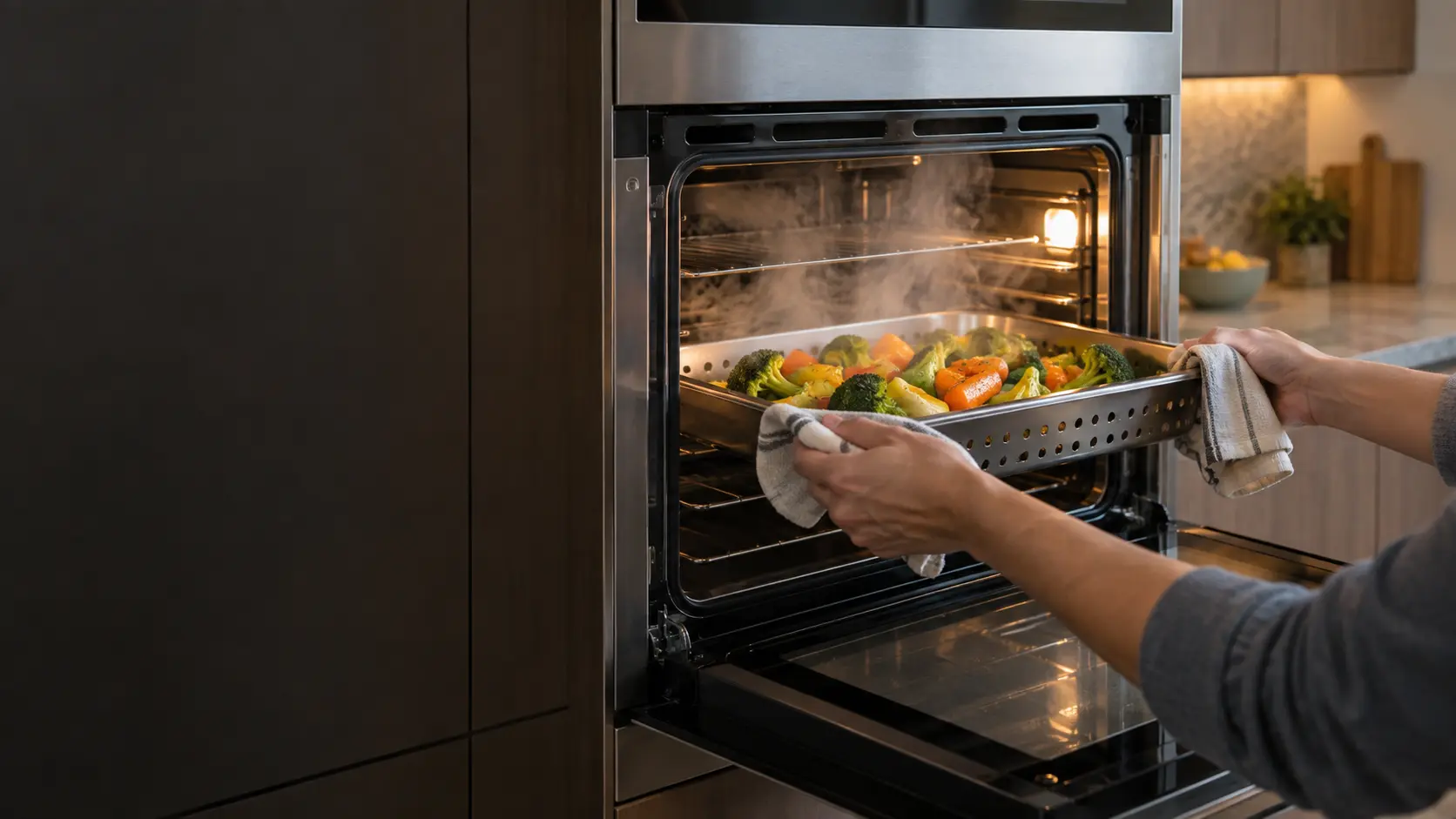

Steam
Oven Repair
A built-in oven that adds water vapor to the cavity, alone or with convection heat, fed from a tank or a water line.
Mon–Sat, 8am–8pm
- 4 things that fail on it
- 11 makes build it
- 6 problems it shows
Book a visit
Three short steps, about a minute.
or call (844) 407-1890
Loading appointment form…
The appointment form couldn’t load. Please try again.
Is yours
a steam?
A steam oven cooks with water vapor from a small generator, either on its own for vegetables, fish and reheating, or mixed with convection heat in a combi-steam model that can also roast and bake. Water reaches the generator from a removable tank that the owner fills, or on some models through a direct water line with a drain. Everything the steam touches meets minerals from the water, so scale builds up in the generator, the pump and the lines, and most steam ovens remind the owner to descale on a schedule. Steam oven repair therefore covers the ordinary oven parts plus a small water system: the tank sensors, the pump, the generator, the valves and the drain.
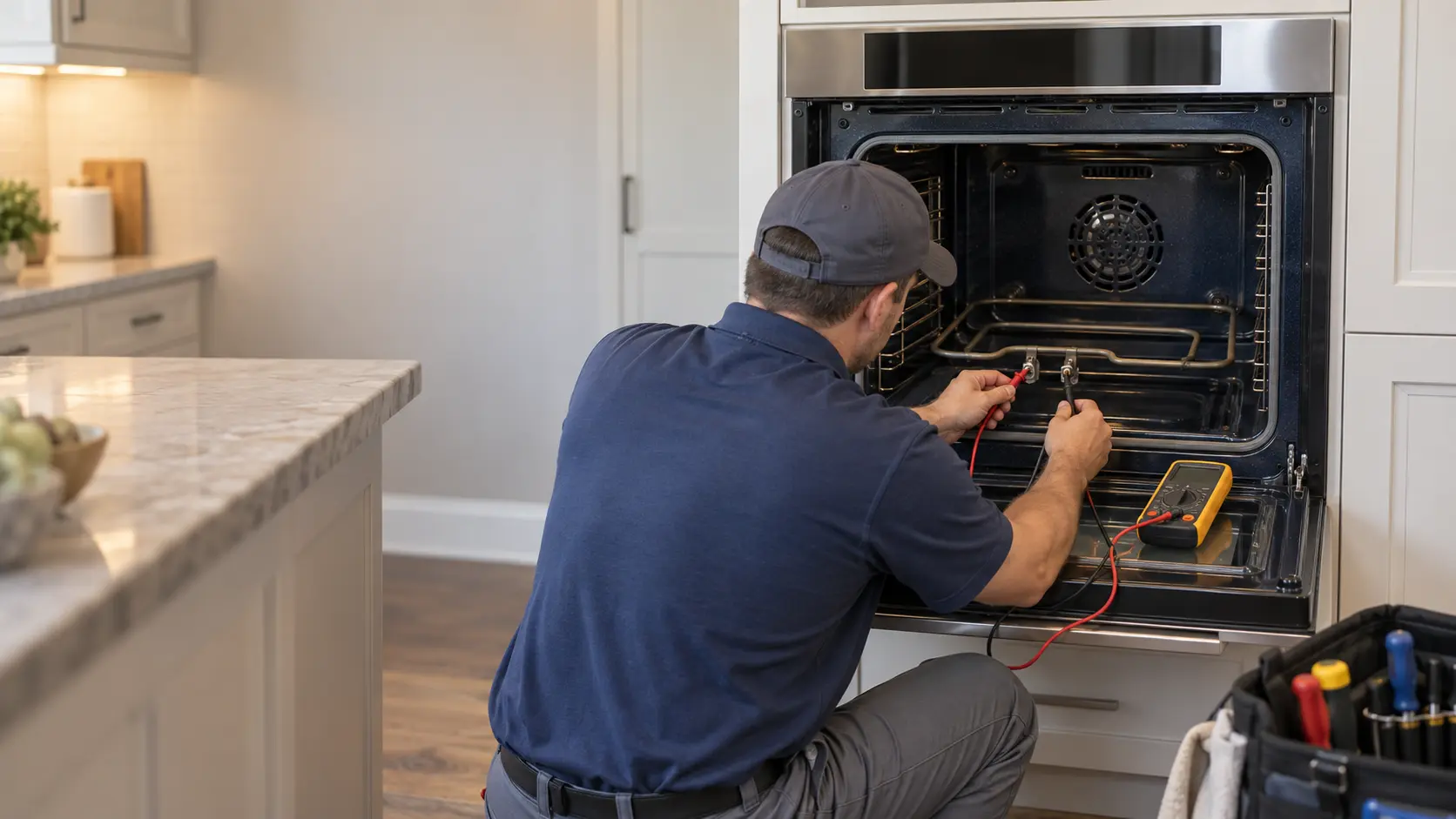 What fails on a steam oven
How to tell
A water tank slides out of a hidden compartment behind the control panel or beside the cavity, or the oven is connected to a water line.
The menu offers steam, combination and descaling programs next to the usual bake and roast settings.
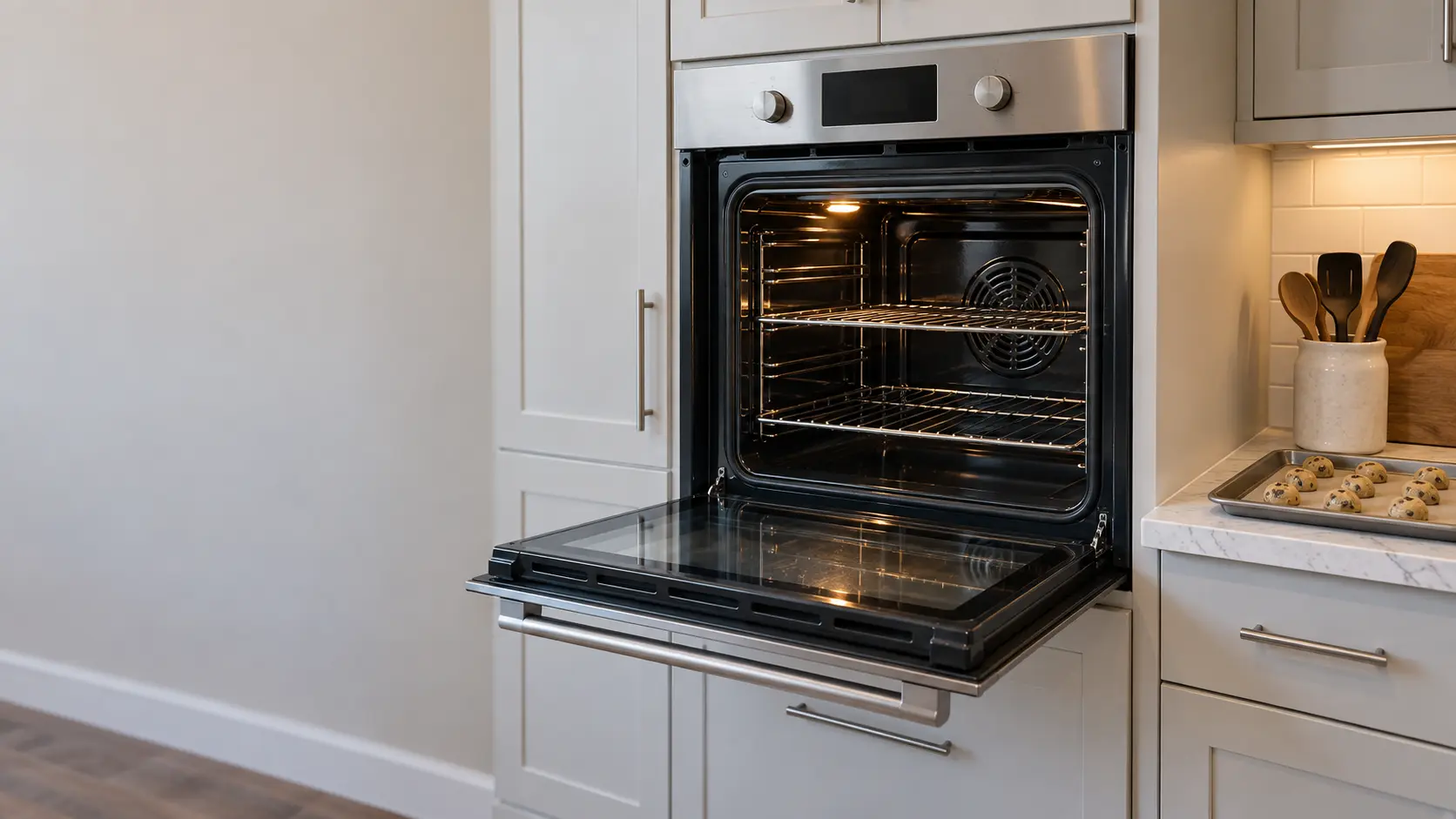
The cavity is often smaller than a full wall oven, commonly built into a cabinet at eye level, sometimes paired with a second oven.
Water collects in a channel or a small well on the floor of the cavity after a steam cycle.
What fails
on this design.
On a steam oven: scale in the steam generator, the water pump and tank sensor, the door seal, drain and water valves on plumbed models.
The problems it showsScale in the steam generator
Minerals from the water coat the generator and slow it down. Steam arrives late and weak, the oven asks to be descaled more often, and a badly scaled generator stops making steam at all.
The water pump and tank sensor
A small pump lifts water from the tank to the generator, and a float or sensor tells the control the tank is in place and full. When either fails, the oven reports an empty tank that is plainly full.
The door seal
Steam escapes past a worn or hardened gasket, fogging the controls and dripping water down the front of the cabinet below the door.
Drain and water valves on plumbed models
A clogged drain line or a sticking inlet valve leaves water standing in the cavity or stops the oven from filling on its own.
Getting at it,
and whether to.
The tank bay, the door seal and the cavity parts are reached from the front, so descaling and seal work rarely move the oven.
What repairs costOn the visit
- The generator and pump live behind or beside the cavity, which on most models means sliding the oven out of its cabinet onto a padded surface.
- On a plumbed model the water supply is closed and the drain line is disconnected before the oven comes out, with towels ready for the water in the lines.
- Power is cut at the breaker first, since a steam oven has both high heat and water inside one cabinet.
Repair or replace
Steam ovens are costly and made by a handful of premium brands, which usually makes repair the better value. Pumps, sensors, seals and even the generator are replaceable parts. A generator that has scaled up once will do it again on the same water, so the repair comes with advice on descaling or filtered water, and replacement is worth weighing only when an older oven's parts are no longer supplied.
Book a visit for a steam ovenThe problems
it shows.
On a steam oven, most often oven error code.
All problems


Who builds
a steam.
11 of the makes on this site build a steam oven. Each mark opens that make's own page.
All 30 brandsSteam oven repair,
where we come out.
9 metros, each with its own page.
All service areasTampa BayFL · 31 areas
Miami / South FloridaFL · 47 areas
New York MetroNY · 75 areas
HoustonTX · 36 areas
ChicagoIL · 50 areas
Los AngelesCA · 95 areas
San DiegoCA · 31 areas

Questions about
steam ovens.
My steam oven says the water tank is empty, but it is full. Why?
How often should a steam oven be descaled?
Can I use tap water in my steam oven?
Why is water dripping from the bottom of the steam oven door?
Is a steam oven harder to repair than a regular wall oven?
Back to your everyday
Is it a steam oven?
Say so when you book — it changes what the technician brings and how the visit is planned.