Why a single thermometer reading misleads
An oven set to 350°F is almost never at exactly 350°F. The control lets the cavity cool a little, switches the heat back on, lets it climb a little past the target and switches it off again, over and over. Whirlpool goes as far as advising owners not to use a thermometer to judge its ovens, because the cycling means the reading at any one moment can be slightly high or low.
The thermometer adds its own error. GE's wall oven manuals warn against the dial thermometers sold in grocery stores for this purpose, saying they may vary by 20 to 40 degrees. Put those two swings together and a reading of 325°F on an oven set to 350°F may be telling you about the thermometer, the moment you looked, or the oven, and there is no way to tell which from one glance.
The oven reads the back wall; you read the rack
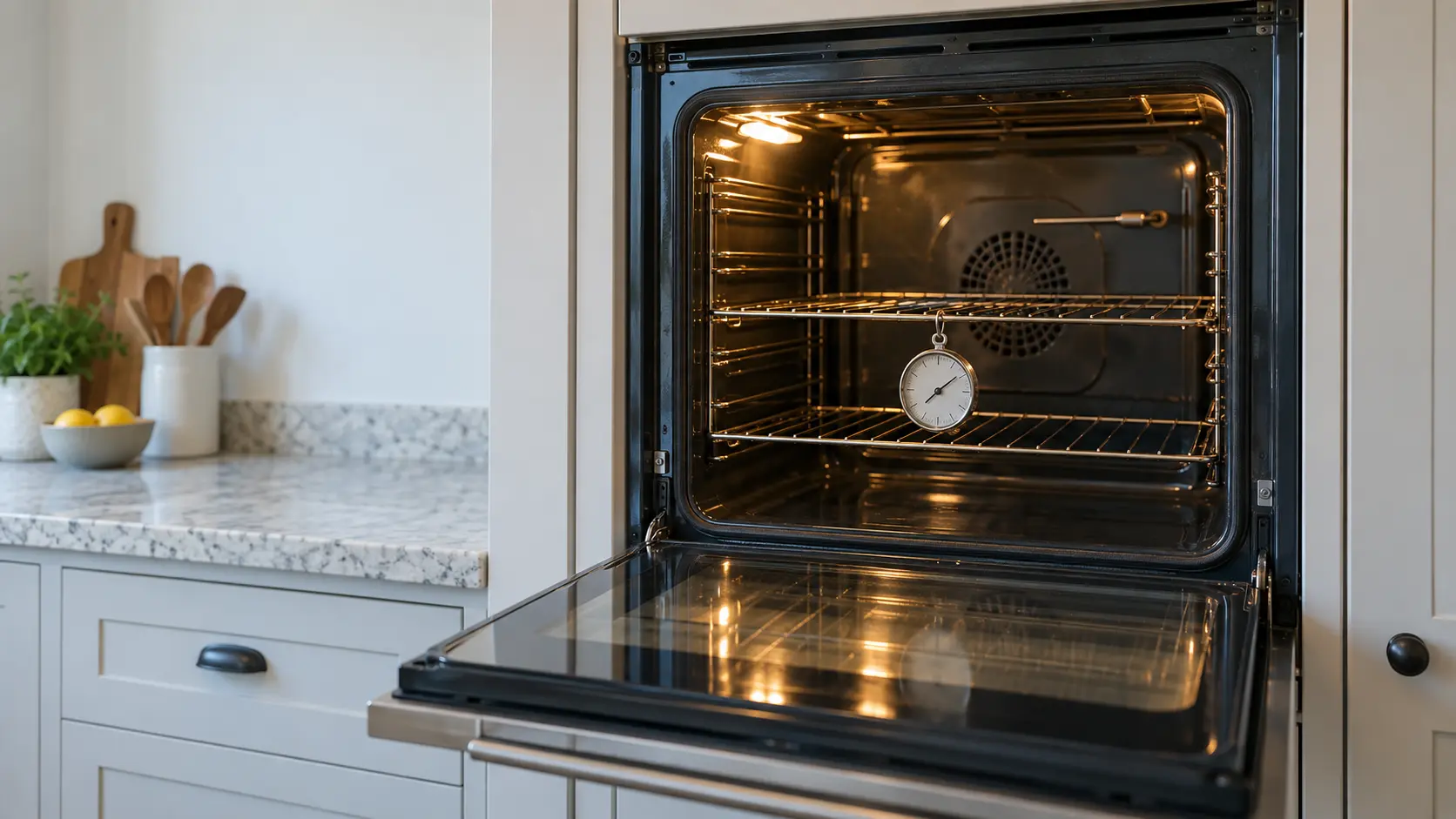
The oven's own sensor is a slim probe on the back wall of the cavity, usually toward the top. A thermometer on the center rack sits in a different pocket of air, closer to the food. Expect a steady gap of a few degrees between the two, and judge the oven by whether the food behaves, not by whether two instruments agree.
Source: Whirlpool — Poor baking results, wall oven — Do not use a thermometer to measure oven temperature; elements cycle, so the oven runs slightly hot or cool at any moment; GE Monogram — 27 and 30 inch convection wall oven owner's manual — Grocery-store oven thermometers may vary 20 to 40 degrees
Check the thermometer before you check the oven
If you plan to use a thermometer, test it first. An instant-read food thermometer with a probe can be checked in a glass packed with ice and topped up with cold water: after a minute of stirring it should read 32°F, and many digital models can be reset to that point. A dial oven thermometer cannot be checked this way, which is one more reason to use it only to watch a trend.
Which thermometer to use
An oven-safe probe thermometer with a cable and a display outside the door is the most useful tool for this test. It lets you read the cavity every few minutes without opening the door, which would drop the temperature and set off another heating cycle.
Whatever you use, keep it in the same spot for every reading and every test, so that one day's numbers can be compared with the next.
- Best: an oven-safe probe with a cable and an outside display
- Good: an instant-read probe checked in ice water, used through a quickly opened door only at the end
- Weakest: a dial gauge hung on the rack, useful only for a trend

Running a fair temperature test
Take out every rack but one and set that one in the center position. Place the thermometer or the probe tip in the middle of the rack, away from the walls, and set a plain bake at 350°F, not convection and not a rapid preheat mode. Let the oven signal that it is preheated, then wait another ten minutes before you begin, since the first cycle after the signal is the least settled.
Now read the temperature every five minutes for half an hour without opening the door, and write each number down. Add them up and divide by the number of readings. The average is the number to compare with the setting; the highest and lowest readings only show how wide the cycle swings.
- One rack, center position, nothing else in the cavity
- Regular bake at 350°F, door closed throughout
- Start ten minutes after the preheat signal
- Six or seven readings, five minutes apart, then average
| Average reading | What it suggests | What to do next |
|---|---|---|
| Within about 10°F | The oven is holding its setting | Look at pans, racks and recipes instead |
| Steadily 15 to 30°F off | A gradual drift the control can correct | Adjust the offset in small steps and bake again |
| More than 35°F off, or swings of 50°F or more | A sensor, relay, element or door seal problem | Book a diagnostic rather than adjusting |
The bake test: let the food decide
Whirlpool's own advice for owners who suspect temperature trouble is a bake performance test before any calibration. The home version needs only a recipe you know well, ideally one printed on a box with a stated time, such as a white cake mix or refrigerated biscuits. Bake it on the center rack in a light metal pan, start timing at the moment it goes in, and note when it is done compared with the time on the box.
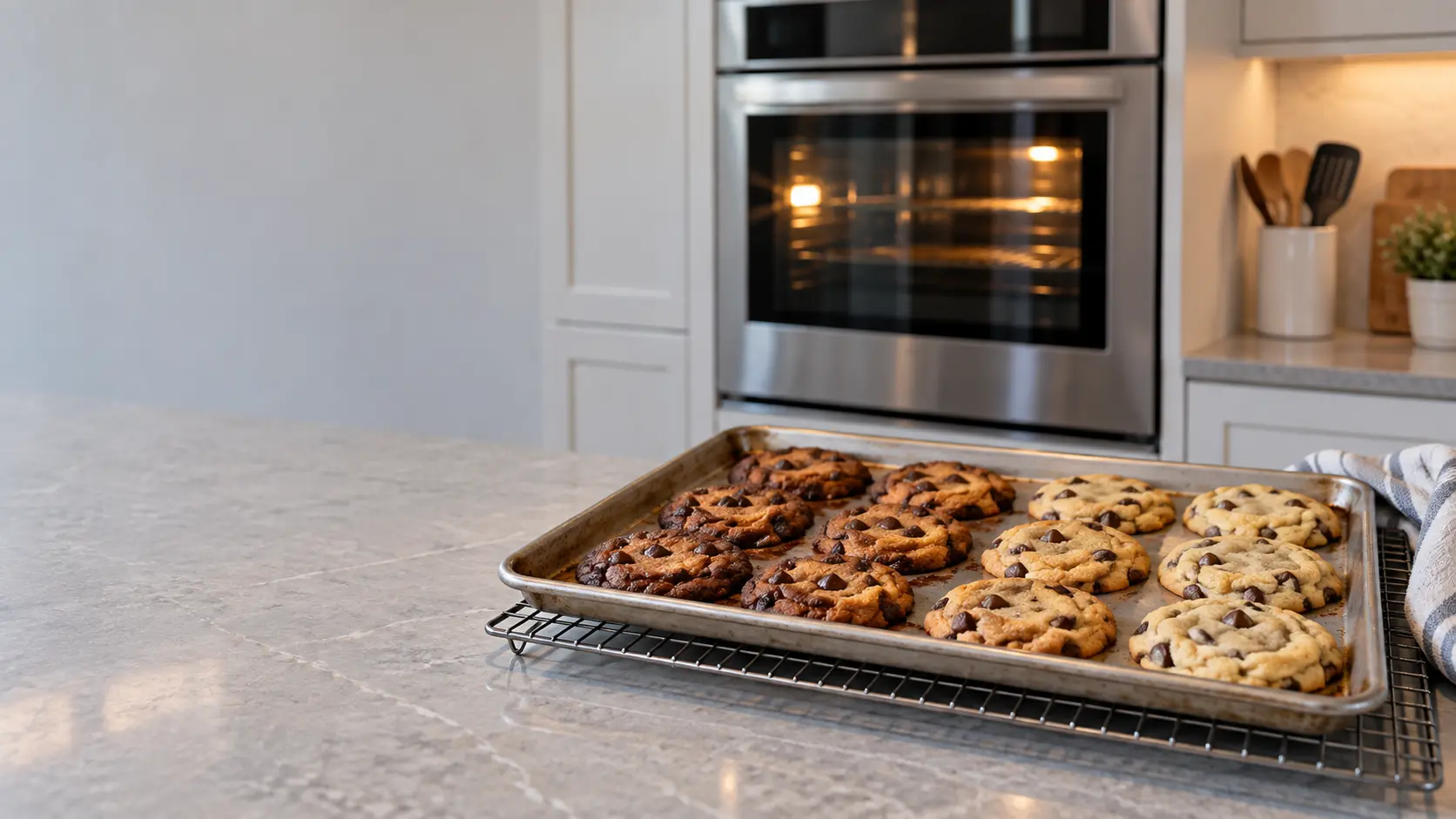
Done within a couple of minutes of the stated time, with even color, means the oven is fine for real cooking whatever a thermometer said. Consistently early and dark suggests the oven runs hot; consistently late and pale suggests it runs cold. Repeat once on another day before changing anything.
Double ovens, steam ovens and speed ovens
Test each cavity of a double wall oven separately, because each has its own sensor and its own adjustment. A combi-steam or speed oven should be tested on its plain convection setting with steam and microwave off, since those modes are not meant to follow a thermometer on the rack.
Source: Whirlpool — Too brown on bottom, wall oven — Perform a bake performance test to determine whether the oven needs calibration
What to do with the result
A steady, moderate error can be corrected from the control's settings menu; GE allows 35°F either way and Whirlpool 30°F, and our guide to ovens that run hot or cold explains how to use the offset. Change it in small steps and repeat the bake test after each change.
Keep your notes. If the test points to a part rather than drift, a technician who can see the readings, the times and the results starts the visit with the diagnosis half done. Food safety does not rest on the oven dial either: check meat and poultry with a food thermometer in the thickest part, whatever the oven reads.
Source: GE Appliances — Built-in electric wall oven owner's manual (JTS3000, JKD3000) — Offset range -35 to +35; upper and lower ovens of a double are adjusted separately; Whirlpool — How to calibrate a wall oven — Calibration between +30°F and -30°F