Where oven failures sit on the cost scale
An oven that will not heat at all feels like the worst news a kitchen can get, yet a cold cavity is often one of the least expensive things to put right. A door that no longer seals, or a panel that flickers after every self-clean, can end up costing more. Before weighing the whole appliance, place the failure in its band. From the lowest to the highest:
- The cheapest kind of repair: a tripped breaker, a control lock left on, a clock that was never set after an outage, a burned-out oven light bulb.
- The low band: a bake or broil element, a temperature sensor, a door gasket, a gas igniter, a thermal fuse that opened after an overheated cycle.
- Moderate: a convection fan motor, a cooling fan, a door lock motor and switch assembly, a set of door hinges, a relay board.
- The top of the scale: the main control board or touch panel on a premium model, a gas valve, the steam generator on a steam oven, the high-voltage parts of a speed oven, or any of these on a model whose parts are discontinued.
A cold cavity is not a verdict
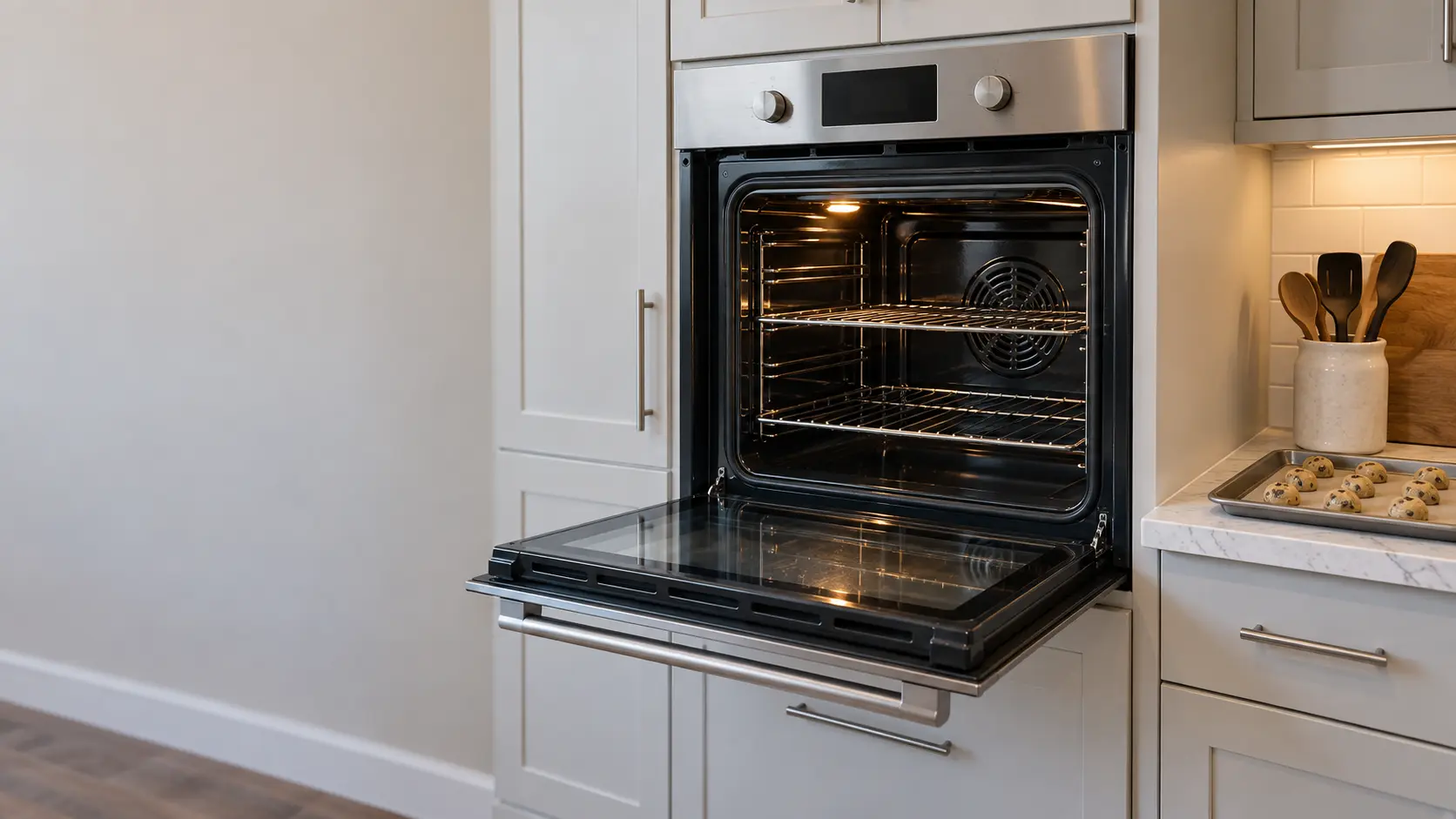
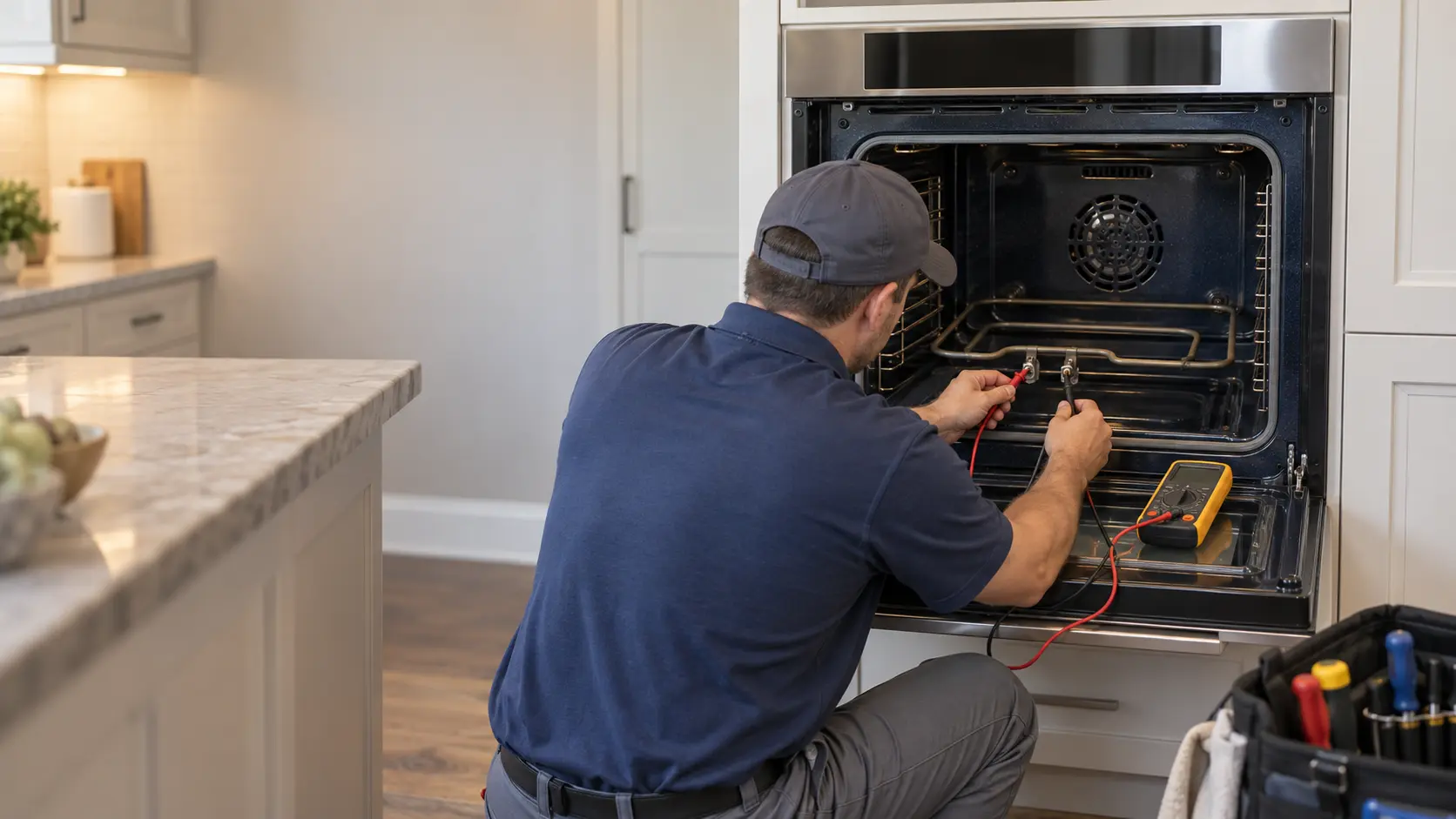
When an electric oven stops heating, the usual suspects are the bake element under the floor panel, the broil element at the top and the power reaching them. On a gas wall oven, a weak igniter that glows but never opens the valve is the classic cause. None of these makes the oven a candidate for the curb, and on most models the part is stocked for years.
When the trouble started with a self-clean
A cleaning cycle heats the cavity far above any baking setting, and the heat that leaks outward reaches the fuse, the fans and the electronics packed above the door. A thermal fuse or a cooling fan that gave up during a clean is a modest repair. A control board that failed the same way is a larger one, and whether it is still sold for your model decides the rest of the conversation.
Source: GE Appliances — Self clean oven frequency of use — Very frequent self-cleaning, more than about once a month, could shorten an oven's life through wear on components and controls
Signs a built-in oven is finished
Some findings make further spending hard to justify on nearly any model. They tend to appear on ovens that have spent many years in heavy use, often with frequent cleaning cycles along the way.
- Porcelain enamel that has chipped and rusted through the cavity liner, so the inner box no longer holds its shape or its insulation.
- A door frame or inner door panel that has warped, so even a new gasket cannot close the gap along one side.
- A main control board or glass touch panel listed as no longer available, with no approved substitute for that model number.
- Wiring inside the cabinet whose insulation has turned brittle and brown from years of trapped heat.
- On a gas model, corrosion at the burner and valve area that would take several parts at once to put right.

How the kind of oven changes the answer
The same failed part leads to different decisions on different ovens, because each design carries its costly components in its own place and ties them to its own cabinet.
| Situation | Usual answer | Main reason |
|---|---|---|
| Any type, element, igniter, sensor or gasket | Repair | The part is stocked and reached through the cavity or the back |
| Double oven, one cavity cold | Repair | The problem is isolated to that cavity's parts |
| Any type, main board discontinued | Usually replace | No part means no fix, however small the problem |
| Steam oven with a scaled-up generator | Depends on age | The generator and pump often need replacing together |
| Rust through the cavity liner | Replace | The liner is the oven's structure and insulation boundary |
Single wall ovens
A single oven has one set of everything and the simplest wiring, so most repairs are short visits. It is also the easiest built-in to exchange, because replacement models in the common widths are made to slip into existing cutouts. That makes an honest comparison with a new unit simpler here than anywhere else.
Double wall ovens
Two cavities share one control and one power connection. A dead element affects only one oven and is a routine job, while a board failure takes out both. Replacing a double oven means removing a heavy unit from a tall cabinet, so repair keeps its advantage for longer than on a single oven.
Steam and speed ovens
These carry a second system on top of the oven parts: a water circuit with a pump and a generator, or a high-voltage section that cooks with microwave energy. Scale damage in a steam generator or a failed magnetron can reach the top band. When the companion oven below is still healthy, repairing keeps the matched cabinet front intact.
The cutout and the circuit set the terms
A built-in oven is part of the cabinetry, so the real question is what it takes to repair or replace a wall oven in this particular opening. Wall ovens are sold in a few nominal widths, and the cutout height and depth behind the same width vary between makers and even between generations of one line. A new model that needs the cabinet cut or shimmed turns a delivery into a carpentry job.
The circuit matters just as much. GE lists 20 amps for its electronic 27- and 30-inch single wall ovens and 40 amps for the double models, so moving from one cavity to two can mean a new breaker and heavier wire from the panel. A gas model needs its own shutoff and a leak-tested connection. Price the swap with those pieces included, not the showroom figure alone.
Source: GE Appliances — Appliance amp size — GE lists 20 amps for its electronic 27- and 30-inch single wall ovens and 40 amps for the double wall ovens