

What a steam oven does with water
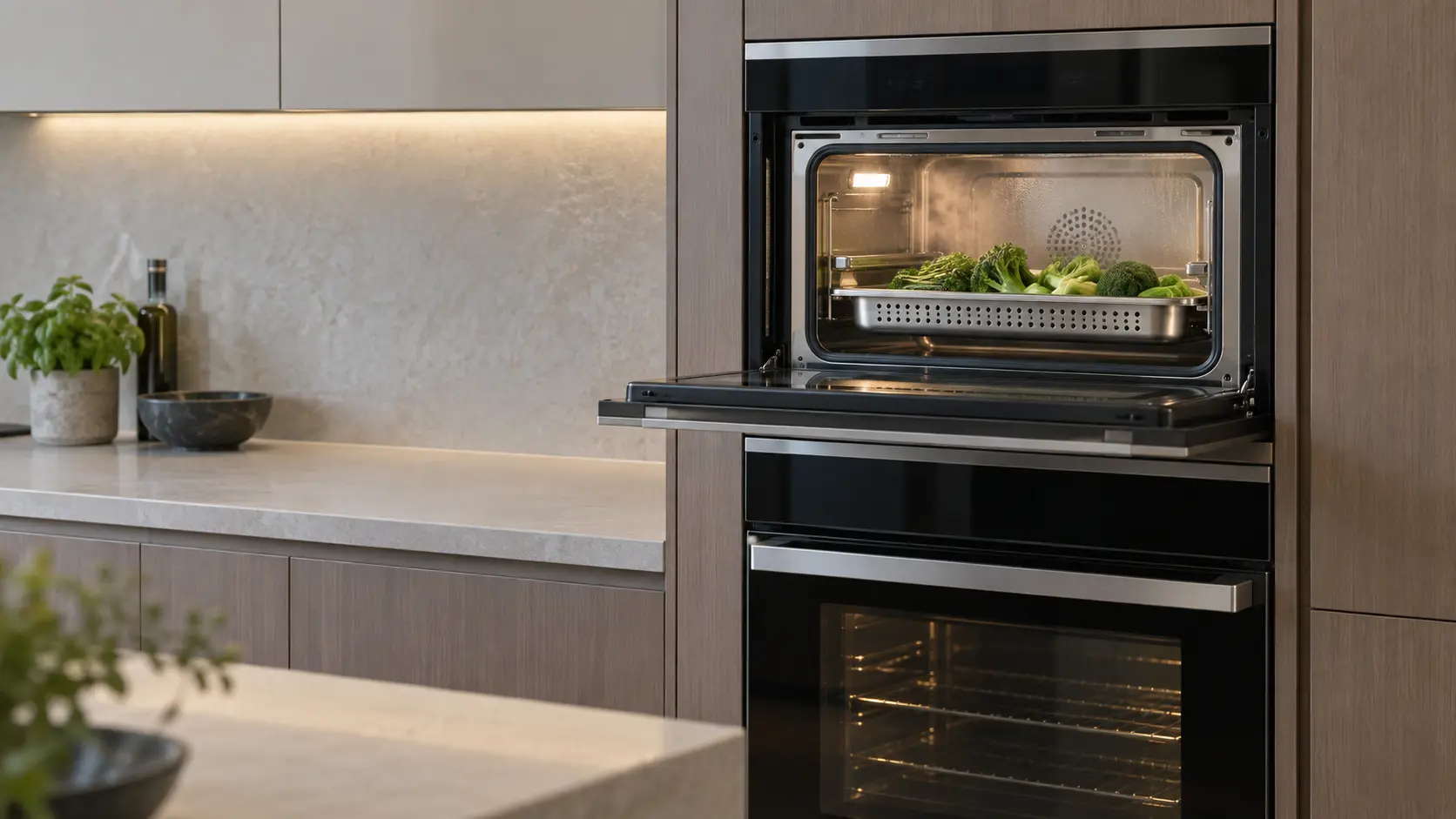
A steam oven turns water into vapor in a boiler or generator and blows it into a sealed cavity. The moist heat reaches food faster than dry air at the same setting and keeps its surface from drying, which is why vegetables stay bright, fish stays tender and yesterday's rice comes back soft instead of crisp at the edges.
Steam-only models
The simplest designs cook with vapor alone and top out around the boiling point of water. They are excellent for vegetables, grains, custards and reheating, but they will not brown a roast or crisp a crust, so they are always a companion to a regular oven rather than a replacement for one.
Combination steam models
A combi-steam oven adds a convection element and fan, so it can run dry heat, steam, or a mix of both in one program. Bread baked with a burst of moisture at the start develops a glossy, crackling crust, and a roast held at a lower setting with some humidity loses less weight. Many owners of these ovens use them for most daily cooking.
A tank you fill or a line to the plumbing
Most models draw from a removable reservoir hidden behind the control panel or beside the cavity, which the owner fills before cooking. Some connect to a water line and a drain, which removes the chore but adds plumbing to the installation and to any later service visit.
Source: Wolf (Sub-Zero Group) — Convection steam oven water requirements — The oven needs minerals in the water for its level sensor; do not use distilled, demineralized or reverse-osmosis water; test hardness with the supplied strip
What a speed oven combines in one cavity
A speed oven pairs a convection element and fan with a magnetron, so microwave energy heats the inside of the food while hot moving air browns the outside. Used together, the two cut the time for a roast chicken or a gratin sharply; used separately, the unit works as an ordinary convection oven or a plain reheating appliance.
The cavity is smaller than a full wall oven, usually about half its height, and many models include a metal rack or tray meant only for certain modes. Reading which cookware each mode accepts is the first thing to do with a new unit, since the rules differ from what owners know from countertop models. The unit also needs its own circuit: GE's built-in Advantium models call for a dedicated 240-volt, 30-amp line or a dedicated 120-volt line on a 15- or 20-amp breaker, depending on the model.
Why the door matters more here
On a speed oven the door is part of the safety system: its hinges, latches and seals keep the high-frequency energy inside the cavity. The FDA advises against using an oven whose door does not close firmly or is bent, warped or otherwise damaged, and a speed oven falls under that advice whenever it cooks in a combination mode.
Source: GE Appliances — Advantium oven electrical requirements and breaker size — Built-in Advantium ovens need a dedicated 208/240 V, 30 A circuit or a dedicated 120 V, 15 or 20 A circuit, by model; FDA — Microwave oven radiation — Leakage is a concern when door hinges, latches or seals are damaged; do not use an oven whose door does not close firmly or is bent, warped or damaged

Which one fits the way you cook
The two answer different complaints about an ordinary oven. Start from what annoys you now.
- If dinner is often late because the big oven takes too long to preheat for one dish, a speed oven solves that.
- If reheated leftovers come out dry or rubbery, a steam oven handles them better than anything else in the kitchen.
- If you bake bread or pastry seriously, a combi-steam oven gives control over humidity that a dry oven cannot.
- If the kitchen has only one spare cabinet space above the main oven, pick the one that covers the meals you cook most on weeknights.
- If refilling a tank and descaling every so often sounds like a chore you will skip, the speed oven asks less of you.
What each asks of the owner
Neither oven is demanding, but each has a routine that decides how long it keeps working well.
- Steam: fill the tank with fresh tap water before each session, empty it afterward, and wipe the cavity and door dry once it cools.
- Steam: run the descaling program when the oven asks; Wolf puts the usual interval at 6 to 18 months, depending on water hardness and use.
- Steam: test the water hardness with the strip or method the manual describes, and adjust the hardness setting to match.
- Speed: keep the door edge and the cavity face clean, since splatter baked onto the seal area stops the door closing flat.
- Speed: use only the racks and trays the manual approves for each mode, and keep foil out of combination programs unless the manual allows it.
Source: Wolf (Sub-Zero Group) — Convection steam oven water requirements — The oven needs minerals in the water for its level sensor; do not use distilled, demineralized or reverse-osmosis water; test hardness with the supplied strip; Wolf (Sub-Zero Group) — Convection steam oven descaling — Descaling is typically needed every 6 to 18 months, depending on use and water hardness
Where the repairs come from
Both ovens carry the ordinary oven parts, an element, a fan, a temperature sensor and a board, plus one system of their own. That extra system is where the two part ways once something needs attention.
| Question | Steam oven | Speed oven |
|---|---|---|
| The extra system | Tank, pump, boiler, valves and sometimes a drain | Magnetron, transformer, capacitor, door switches |
| Where trouble tends to start | Scale left to build up in the boiler and pump | Door switches and the high-voltage section |
| What the owner can prevent | Most scale damage, by descaling on schedule | Door damage, by keeping the seal area clean and closing gently |
| Parts no owner should touch | The water connection behind the unit | Everything behind the cabinet panel, which can stay charged after power is off |