
What sits behind a gas wall oven
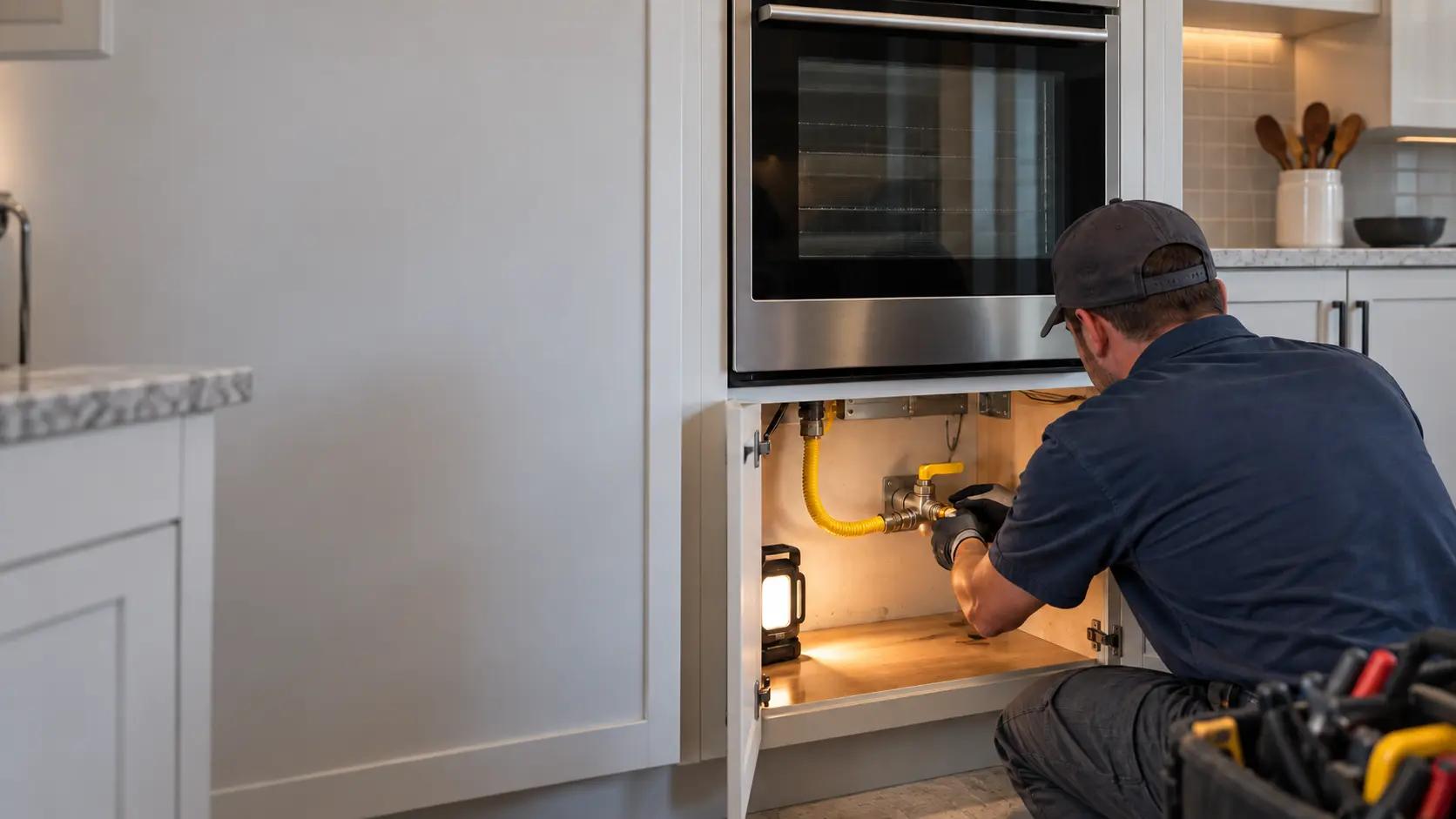
GE's installation instructions for its 24-inch gas built-in oven show the layout that most gas wall ovens share. Read from the house pipe toward the oven, a correct gas wall oven connection has these parts, all inside the cabinet space:
- The house gas line, ending in a short pipe nipple inside the cabinet.
- A manual shutoff valve for the oven alone.
- Either coated, approved flexible metal tubing where local codes permit it, or rigid pipe with a union.
- An adapter joining that line to the oven's pressure regulator.
- The regulator itself, at the back of the oven, with a shutoff lever of its own.
- A grounded 120-volt outlet for the controls, igniters and light.
The shutoff valve and why you should know where it is
GE's owner's manual asks owners to have the installer show them where the oven's gas shutoff valve is and how to turn it off. On a wall oven it is often reached through a cabinet door below or beside the oven. Knowing it matters for a planned repair or a remodel; it is not something to reach for during a gas smell, when the only job is to get out.
Local codes change the details
Codes set what is allowed, and they differ by state and city. GE's sheet notes that in Massachusetts a ball-type shutoff valve must have a T-handle and a flexible connector may be no longer than 3 feet. Where there is no local code, GE points installers to the National Fuel Gas Code, ANSI Z223.1.
Source: GE Appliances — Installation Instructions, 24-inch Gas Built-In Oven JGRP20 (31-2000792) — Parts from gas line and shutoff valve through flexible or rigid connection to the regulator with its own shutoff; T-handle valve and 3-foot connector limit in Massachusetts; National Fuel Gas Code; never reuse old connectors; pipe compound resistant to LP; soap-solution leak test, no open flame, all leaks stopped before lighting; disconnect above 1/2 psig; blue flames with no yellow; factory set for natural gas, LP conversion by a qualified installer or gas supplier; keep instructions for the inspector
A new connector, and threads sealed for the gas you use
The flexible connector is the piece that gets bent, twisted and pinched as an oven is lifted into its opening, which is why GE is firm about it: shut off the supply, discard any old or used connector, and use a new one with every installation, because old flexible connectors can leak and cause injury. The instructions also warn against putting strain on the oven's own gas inlet while the connection is made.
Threaded joints are sealed with a pipe joint compound that resists propane, applied to the male threads. The connector has to reach the regulator without being stretched or crushed when the oven is pushed home, and that is judged before the oven goes into the cutout, not after.
A connector from the old oven can look perfectly sound and still fail. Its fittings were tightened once against a different inlet, and the tubing has already been flexed into one shape. Starting with a fresh one costs little next to the price of a callback for a leak, which is why a careful installer brings it along without being asked.
Source: GE Appliances — Installation Instructions, 24-inch Gas Built-In Oven JGRP20 (31-2000792) — Parts from gas line and shutoff valve through flexible or rigid connection to the regulator with its own shutoff; T-handle valve and 3-foot connector limit in Massachusetts; National Fuel Gas Code; never reuse old connectors; pipe compound resistant to LP; soap-solution leak test, no open flame, all leaks stopped before lighting; disconnect above 1/2 psig; blue flames with no yellow; factory set for natural gas, LP conversion by a qualified installer or gas supplier; keep instructions for the inspector

How the installer proves there is no leak
Once the oven is connected, GE's procedure is a soap-solution test: brush it over every joint from the supply line to the manifold and oven, turn the gas on, and watch for bubbles. Any bubbling joint is shut off, tightened and tested again. The instructions put two warnings in capital letters: never use an open flame to look for leaks, and stop every leak before trying to light the burners.
When a plumber tests the house piping
Gas lines are sometimes pressure-tested during renovations. GE's instructions say the oven and its shutoff valve must be disconnected from the house piping for any test above 1/2 psi, and isolated by closing its valve for tests at or below that. The pressures used in those tests are not meant to reach the oven's regulator, so mention the oven to anyone working on the gas lines.
Checking the flames
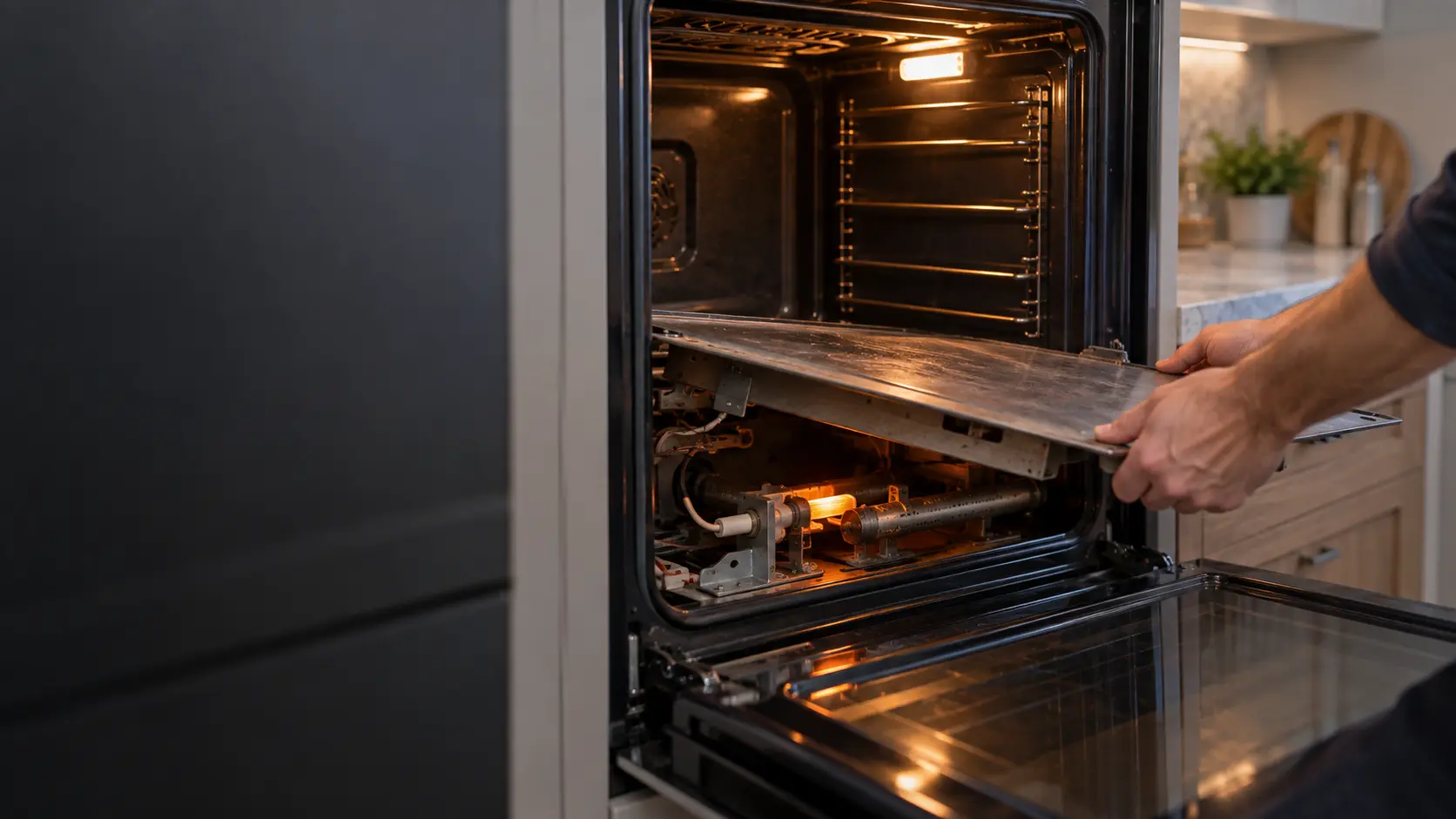
The last step is to watch the bake and broil flames through the closed door. GE describes a good flame as blue with no trace of yellow, not fluttering or lifting off the burner. Adjusting the air shutter to get there is part of the installation, and a yellow or lifting flame later in the oven's life is a reason to book a check.
Source: GE Appliances — Installation Instructions, 24-inch Gas Built-In Oven JGRP20 (31-2000792) — Parts from gas line and shutoff valve through flexible or rigid connection to the regulator with its own shutoff; T-handle valve and 3-foot connector limit in Massachusetts; National Fuel Gas Code; never reuse old connectors; pipe compound resistant to LP; soap-solution leak test, no open flame, all leaks stopped before lighting; disconnect above 1/2 psig; blue flames with no yellow; factory set for natural gas, LP conversion by a qualified installer or gas supplier; keep instructions for the inspector
Natural gas or propane
GE's gas wall oven leaves the factory set for natural gas, the supply most US homes on a utility line receive. A house on propane, sometimes called LP or bottled gas, needs the oven converted first: the pressure regulator is switched to its LP setting and the burner orifices are changed. GE warns never to run the burners on propane before that conversion, and says the conversion must be done by a qualified installer or the gas supplier.
If you are not sure which gas your house uses, the utility bill or the tank in the yard answers it. Tell the installer before the oven is ordered, because the conversion parts have to be on hand on installation day.
Source: GE Appliances — Installation Instructions, 24-inch Gas Built-In Oven JGRP20 (31-2000792) — Parts from gas line and shutoff valve through flexible or rigid connection to the regulator with its own shutoff; T-handle valve and 3-foot connector limit in Massachusetts; National Fuel Gas Code; never reuse old connectors; pipe compound resistant to LP; soap-solution leak test, no open flame, all leaks stopped before lighting; disconnect above 1/2 psig; blue flames with no yellow; factory set for natural gas, LP conversion by a qualified installer or gas supplier; keep instructions for the inspector
What falls to the owner, and what does not
GE's sheet asks installers to leave the instructions with the owner and owners to keep them for the local inspector, which is a good hint about how the connection is judged. The owner's part is small but real, and it is the part that keeps the connection safe for years:
- Keep the installation instructions with the oven's paperwork.
- Know where the oven's shutoff valve is, and leave it alone unless a technician asks.
- Keep a working carbon monoxide alarm in the home.
- Glance at the burner flame through the window now and then.
- Tell anyone working on the house gas lines that there is an oven on them.
Source: GE Appliances — Installation Instructions, 24-inch Gas Built-In Oven JGRP20 (31-2000792) — Parts from gas line and shutoff valve through flexible or rigid connection to the regulator with its own shutoff; T-handle valve and 3-foot connector limit in Massachusetts; National Fuel Gas Code; never reuse old connectors; pipe compound resistant to LP; soap-solution leak test, no open flame, all leaks stopped before lighting; disconnect above 1/2 psig; blue flames with no yellow; factory set for natural gas, LP conversion by a qualified installer or gas supplier; keep instructions for the inspector